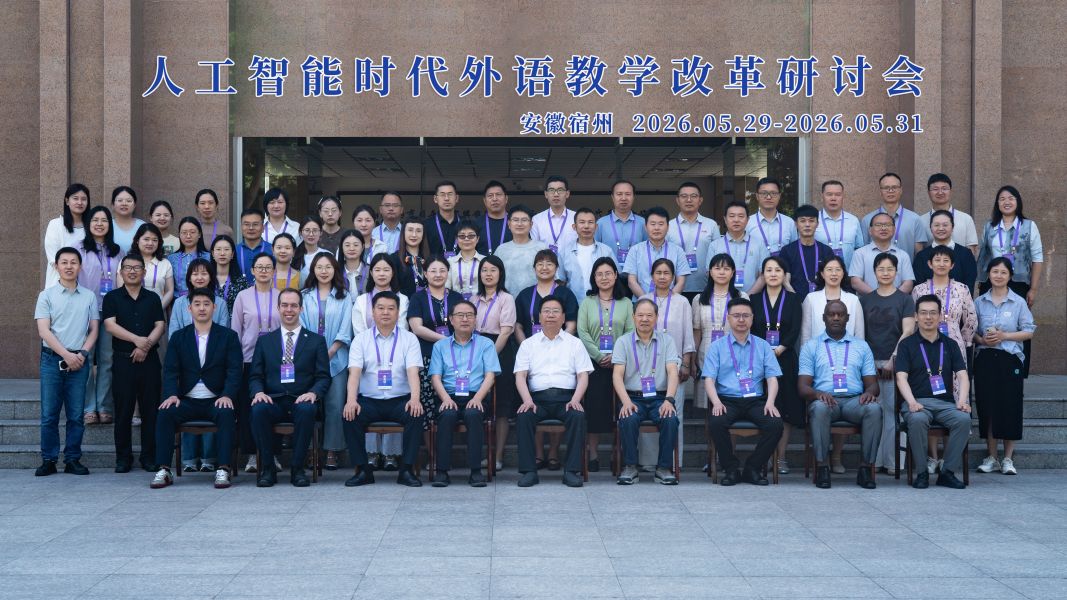
AI in Language Education at Suzhou University, 2026
On May 29–31, 2026, I returned to Suzhou University in Anhui Province for the second time in two years — this time for the Symposium on Foreign Language Teaching Reform in the AI Era (人工智能时代外语教学改革研讨会), co-hosted with Fuyang Normal University. About 150 educators gathered to work through a question that no longer feels theoretical: not whether AI belongs in the language classroom, but how to redesign roles, curricula, and ethics now that it is already there.
Below is my summary of the keynote research. I have organized it by theme rather than by speaker order, because that is how the ideas actually connected in the room.
This post was written with the assistance of AI.
Three tensions running through the conference
Three threads kept reappearing across the keynotes.
Opportunity versus equity. AI promises personalization at scale, but several speakers showed that the promise is unevenly distributed. Zhu Yue of Anhui University cited national survey data showing sharp gaps between eastern and western China in network infrastructure, smart-board adoption, AI teaching coverage, and teacher digital literacy. In some comparisons, urban teachers’ daily use of national education platforms ran four times longer than their rural counterparts. Zhao Congyi of Fuyang Normal University described a parallel problem at the institutional level: many foreign-language teachers know AI exists but lack familiar tools, practice environments, and time to experiment.
Human agency versus automation. Li Xiaopeng of National University of Defense Technology argued philosophically that generative AI is a powerful intertextual machine — it recombines existing texts brilliantly — but not a genuine dialogic partner capable of intersubjectivity, the mutual recognition that both speakers can change each other’s thinking. Kizito Tekwa of the University of Ottawa offered an empirical counterweight: students who critically reviewed AI-generated paragraphs improved their own writing, but only when they worked individually did they reliably transfer that critique into their drafts. The lesson from both talks is similar: AI assists learning when humans stay in the critic’s chair.
Chat versus systems. My own presentation pointed to a practical version of the same idea. Most teachers still copy text into a chat window and copy it back out. That workflow works until you need files, multi-step tasks, or runnable tools — which is exactly what language-technology education increasingly requires.
Teacher roles and AI literacy
The conference opened with a policy-scale view from Zhu Yue on teacher role transformation in the digital era. His argument was that the traditional “knowledge transmitter” role is weakening not because teachers matter less, but because standardized explanation is now cheap. What remains indispensable is design, diagnosis, and values: learning designer, data-informed instructor, emotional guide, and ethics gatekeeper.
Zhu proposed a five-dimension competency model for the intelligent era: AI awareness and philosophy; AI application integrated across teaching; cross-disciplinary fusion; data-driven instructional decisions; and ethics and security. The model is not a checklist — he described three interacting chains, where ethical awareness filters data use, application generates evidence, and evidence refines philosophy.
Zhao Congyi offered a complementary four-dimension framework tailored to foreign-language faculty: cognitive understanding of what AI can and cannot do; value attitude anchored in “education first, AI as tool” (育人为本、AI为器); scientific-educational application; and ethical responsibility. He drew on Celik’s AI literacy framework and UNESCO’s 2024 AI competency framework for teachers, but localized the discussion with campus cases that made the abstractions feel usable.
Two examples stood out. In a course on Chinese cultural communication, teachers used Doubao AI as a “cultural language partner” — answering background questions before class, modeling idiomatic expressions during class, and giving personalized writing feedback after class. A unit on Peking duck moved from vocabulary drill to cross-cultural comparison: students asked why duck is considered “cooling” in traditional Chinese medicine, practiced food-host interview language in class, and wrote essays comparing roast duck to hometown dishes with AI-assisted revision.
In translation pedagogy, Zhao described a human-machine collaborative workflow on the “试译宝” platform: students submit pre-class trial translations, compare AI translation, AI polishing, and prompt-engineered translation in class, and receive both intelligent scoring and teacher evaluation. The point is not to replace the translator but to make prompt design, post-editing, and domain knowledge visible parts of the curriculum.
Wang Peng of the Hefei Academy of Educational Sciences rounded out the policy layer with five principles for AI in English teaching: appropriateness (适切性), ease of use (易用性), stability (稳定性), student agency (主体性), and criticality (批判性). He traced AI’s evolution from Dartmouth 1956 through narrow AI, generative AI, large models, and AI agents, then mapped current Ministry of Education guidance — “AI to assist learning, teaching, and research” — onto concrete EFL scenarios: personalized reading paths, conversational practice, writing support, and real-time feedback aligned with the 2025 Guidelines for Generative AI Use among Primary and Secondary Students.
Redesigning the classroom
If the first cluster of talks asked who the teacher becomes, the next asked what the classroom becomes.
Cao Jun of the Anhui Provincial Foreign Language Association made the strongest pedagogical case for Understanding by Design (UbD) fused with Project-Based Learning (PBL). UbD is backward design: decide what enduring understanding you want, design evidence of that understanding, then plan learning experiences. PBL is not a dessert activity tacked onto a finished unit — it is the main course, a sustained inquiry ending in a public product.
Cao’s worked example, “My Hometown’s Palette,” used a seventh-grade English unit on colors to build cultural identity. Students moved through essential questions like How do colors shape our memories of a place? and produced posters or short videos introducing their hometown’s palette to an authentic audience. He walked through GRASPS task design (Goal, Role, Audience, Situation, Product, Standards) and the WHERETO framework for sequencing experiences — hook, explore, rethink, evaluate, tailor, organize.
Wang Peng’s contribution on the English classroom emphasized generative AI’s four research-backed orientations in EFL: intelligent content generation, conversational support, writing coaching beyond grammar correction, and real-time analytic feedback. His examples tied these orientations to textbook units on plants and disaster response, showing how teachers can use AI to extend reading-for-writing tasks rather than replace them.
Kizito Tekwa’s study, “Do Two Heads Write Better Than One?”, gave the conference its clearest experimental result. Fifty-six first-year academic writing students individually critiqued AI-generated descriptive paragraphs, then either wrote in groups (n=27) or individually (n=29). Overall writing quality did not differ much, but the pattern of how students learned from AI did:
- Groups wrote significantly longer paragraphs, with stronger thesis statements and grammar scores, and reported much higher motivation and self-efficacy after the task.
- Individuals were far better at transferring their AI critique into their own writing: 100% success at reproducing strengths they had identified in AI text, versus 56–72% for groups; weakness repetition dropped from 55% to 32% for individuals but stayed around 60% for groups.
His teaching recommendation matched what many of us already do informally: group brainstorming and drafting, then individual revision — use collaboration for energy and volume, use solitude for critical transfer.
Philosophy, epistemology, and global context
The most abstract — and in some ways most necessary — talks asked what kind of knowledge AI actually produces.
Li Xiaopeng’s keynote, “Can Human-Machine Dialogue Achieve Knowledge Innovation?”, drew on Bakhtin, Habermas, and Kristeva to distinguish intersubjectivity from intertextuality. True dialogic knowledge creation requires both parties to treat the other as a potential source of new meaning. Generative AI, by contrast, operates through statistical prediction over prior text — Li called it a “giant intertextual machine” with extraordinary retrospective reach but no embodied forward-looking stance. Human-AI dialogue can be useful, he argued, but the human supplies the subjectivity, the intention, and the openness to being changed.
Zhang Xiaorong’s talk on large language models, language epistemology, and foreign-language major construction bridged classical linguistics with the current moment. Tracing the arc from Chomsky’s Knowledge of Language and the innateness hypothesis through Universal Grammar, he asked what the “language faculty” means when students also learn from models trained on the entire internet. His slides pointed toward new professional identities for language graduates — language advisor, language partner, language assessment specialist — and toward prompt engineering as a core skill for the major. (I am summarizing here from partial slide content; the legacy .ppt format did not yield a full transcript.)
Benjamin H. Nam of the University of Tennessee placed the conference in a global comparative frame. Using C. Wright Mills’s sociological imagination and Bourdieu’s concepts of habitus, cultural capital, and linguistic hegemony, he examined China’s rise in AI-STEAM research alongside transnational academic mobility under the Belt and Road Initiative. China hosted nearly half a million international students by 2018–2019, with a growing share at the postgraduate and doctoral level; simultaneously, Chinese students remain the largest group in Anglophone knowledge hubs. Nam’s question for the academy was reflexive: how does cosmopolitan knowledge reproduction change when the center of research gravity shifts?
My presentation: From LLMs to Agents
I spoke on the last day about a shift I see in my own teaching at Beijing Language and Culture University: from cloud-based LLMs to AI agents that work on your files and carry tasks through to completion.
Most of us already use LLMs by copying text into ChatGPT and copying answers back. That pattern has three natural limits: the model cannot see your course folder, it requires constant back-and-forth for complex outputs, and it cannot deliver a runnable tool — only text about one.
Agents change the equation. An agent can read and write files, run Python, browse the web, and keep working on a multi-step task without you reprompting every minute. The progression, following Maarten Grootendorst’s visual guide, runs from a plain LLM (prompt → answer), to an augmented LLM with fixed tool steps, to an autonomous agent that plans, acts, observes results, and replans until done.
I demonstrated three use cases from my own courses:
-
Textbook to HTML class notes. I paste a chapter into a plain
.txtfile, point an agent at the folder of exhibit images, and ask it to build a self-contained HTML page with glossary entries after first mention of key terms and collapsible classroom activities. The whole workflow takes about fifteen minutes. -
Interactive edit-distance tool. In my language-technology course, I ask an agent to build a small Python app live while students watch: type two words, see Levenshtein edit distance and the step-by-step transformation table. Five minutes to a working demo; I write no code myself.
-
Exam generation pipeline. From a plain-text question bank, the agent converts to JSON, generates randomized HTML, exports a CSV answer key, and formats landscape A4 pages ready to print.
The efficiency gain I care about most is agent skills — saving a workflow as a reusable instruction file so the next lesson starts with “use the class notes skill” instead of retyping the recipe. Tools worth exploring include Cursor, Claude Cowork, and TRAE SOLO, which is accessible and affordable in China. My action items for the audience were practical: install Python, work in text-based formats (.txt, .md, .html, .json, .csv), and when a workflow works, save it as a skill.
What I took away
Two years ago I spoke at Suzhou about the post-localization landscape facing translation graduates. This year’s conversation had moved upstream — into teacher identity, curriculum design, classroom evidence, and the philosophy of knowledge itself. Nobody was asking whether to use AI. They were asking how to use it without surrendering judgment, equity, or the human relationships that make language education worth doing.
The best talks shared a design instinct: AI works when teachers and students stay in the driver’s seat. Cao Jun’s UbD-PBL fusion keeps purpose and assessment in human hands. Zhao Congyi’s campus cases treat AI as a partner under teacher oversight. Kizito Tekwa’s data show that critique, not consumption, is what improves writing. Li Xiaopeng reminds us that dialogue still requires a dialogic subject — and in the classroom, that subject is the student or the teacher, not the model.
My contribution was the practical corollary: the next step for language-technology educators is to stop treating AI as a chat window and start treating it as a builder of teaching systems — notes pages, interactive tools, exam pipelines, and reusable skills that accumulate over a career.
Thank you again to Suzhou University and Fuyang Normal University for the invitation.